
Exam Information
A comprehensive guide to the CGIB exam, detailing each level, module, and the procedures on exam day.
CGIB Exam Dates & Fees
The CGIB exam is a three-part exam – Level I, Level II, and Level III. Testing the knowledge and skills of financial analysts, each level of the curriculum builds on the prior level, becoming increasingly complex.
These three levels equip you with real-world skills in investment analysis and make up the CGIB Program. Once completed, you can become a globally recognized Chartered Global Investment Banker (CGIB) – a prestigious distinction that differentiates you in the competitive finance industry.
Exam Levels & Pricing
- 10 Comprehensive Modules
- Investment Banking Fundamentals
- Online Proctored Exam
- 10 Advanced Modules
- M&A and LBO Mastery
- Online Proctored Exam
- 10 Strategic Modules
- Global Leadership Focus
- Online Proctored Exam
Exam Approach
The CGIB® Level 1 exam introduces candidates to the foundational pillars of investment banking, integrating theory with practice. It focuses on developing technical literacy, professional ethics, and market awareness essential for an analyst's role.
Through a mix of conceptual frameworks, financial tools, and case-based learning, Level 1 builds the groundwork for Level 2's advanced applications. Candidates gain a holistic view of global capital markets, corporate finance, accounting, and valuation fundamentals—preparing them to interpret real-world transactions and financial statements confidently.
All modules are reviewed annually by the CGIB Global Curriculum Committee to ensure alignment with the rapidly evolving investment banking ecosystem.
Exam Level-Wise Curriculum
This introductory module orients candidates to the investment banking ecosystem, its structure, evolution, and core functions. It explains how investment banks facilitate global capital formation, serve corporate clients, and interact with investors and regulators.
This module introduces the major financial instruments and markets that define global investing. Candidates gain a clear understanding of how instruments are issued, traded, and valued.
This module develops analytical capability using a top-down investment approach, connecting macroeconomic indicators with industry and company performance.
Candidates learn to interpret financial statements from a banker's perspective—understanding how accounting decisions impact valuation, lending, and deal-making.
This module provides an essential foundation in corporate decision-making and valuation—core to investment banking advisory.
An applied learning module that introduces candidates to risk-adjusted returns and the behavioral and ethical dimensions of market integrity.
This module introduces the credit evaluation frameworks used by banks and rating agencies to assess borrowers and issuers.
Candidates gain insight into the global capital ecosystem, from early-stage investors to institutional funds.
A practical introduction to deal execution and documentation across major investment banking activities.
The concluding module instills the ethical and regulatory discipline essential for banking professionals operating in global markets.
This advanced module transforms foundational corporate finance into applied investment banking execution. Candidates master integrated financial modeling, including 3-statement model construction, forecasting, and sensitivity/scenario analysis.
Candidates advance to complex valuation methodologies used in global investment banking and equity research. The focus is on practical application across varying deal contexts.
A deep strategic dive into the M&A lifecycle, covering rationale, pricing, negotiation, and integration. The module emphasizes deal psychology and cross-border complexities.
Candidates explore LBO mechanics and the art of structuring leveraged transactions for optimal value creation. This includes hybrid and tax-efficient deal design.
This module equips candidates to analyze and execute restructuring mandates, turnaround strategies, and post-merger integrations.
Focused on buy-side finance, this module introduces advanced PE, VC, and alternative investment strategies. It emphasizes fund structures, due diligence, and exit planning.
An in-depth examination of global debt market operations, syndication processes, and regulatory frameworks. Candidates learn to originate, structure, and price debt issues.
This module provides mastery over equity issuance processes and public offering mechanics, from pre-IPO strategy to listing execution.
Candidates learn to execute specialized equity transactions beyond IPOs—aligning capital strategy with investor targeting and governance considerations.
This capstone module reinforces ethical judgment, regulatory acumen, and risk management discipline essential for leadership roles in global finance.
This module provides a deep and practical understanding of credit risk and asset quality management across the global banking ecosystem. Candidates learn how credit exposures evolve, how to identify early warning signals, and how to conduct asset quality reviews under Basel III and RBI norms. It covers credit appraisal for leveraged transactions, project finance, and buyout funding.
This module develops advanced proficiency in corporate insolvency resolution under India's IBC 2016 and comparable frameworks such as U.S. Chapter 11 and the U.K. Administration process. Candidates examine every stage of the CIRP, roles of CoC, IRP, ARCs, and NCLT, and distressed company valuation under uncertainty.
This module equips candidates with comprehensive regulatory intelligence to execute global M&A, IPO, and capital market transactions compliantly. It covers the functions of the SEC (U.S.), FCA (U.K.), SEBI (India), and MAS (Singapore) across securities, listing, and takeover laws.
This practical, document-centric module develops expertise in drafting and interpreting deal-related agreements. Candidates work through NDAs, engagement letters, term sheets, SPAs, underwriting contracts, shareholder agreements, and indemnity clauses.
This module bridges corporate governance with investment banking execution. It covers the Companies Act, 2013, SEBI (ICDR, SAST, LODR) regulations, FEMA, FDI, and comparable international frameworks like U.S. SEC and EU AIFMD.
This specialized module focuses on structuring and financing large-scale infrastructure and real estate transactions. Candidates explore REITs and InvITs as hybrid capital instruments combining features of equity IPOs and debt placements.
This module provides comprehensive training in corporate and capital markets taxation, including tax planning for M&A, LBOs, PE/VC exits, and IPOs. It covers corporate tax, capital gains, dividend distribution, and transfer pricing under DTAA, GAAR, and BEPS frameworks.
A forward-looking exploration of how insolvency, restructuring, and resolution frameworks are evolving globally. Candidates study pre-packaged insolvency for MSMEs, group insolvency, and ESG-linked resolution structures.
This leadership module reinforces ethical judgment and fiduciary accountability in complex financial environments. Candidates examine governance challenges during IPOs, M&A, and fund transactions – including conflict of interest, insider trading, and client confidentiality.
The capstone module integrates financial strategy, governance, and leadership excellence. Candidates design enterprise-wide risk frameworks for M&A, leveraged finance, IPOs, and fund operations. Graduates emerge ready for C-suite and policy roles within international investment banks and financial advisory firms.
Eligibility and Requirements
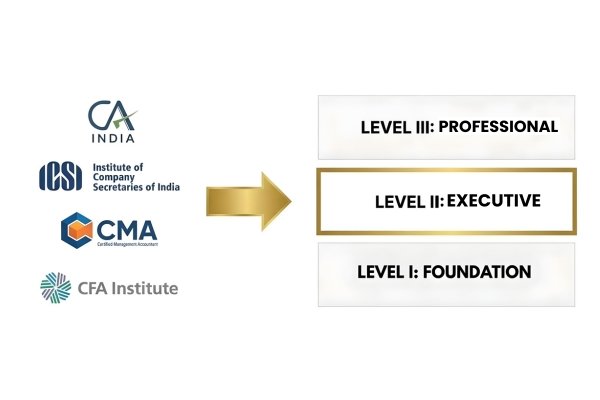
Undergraduates, graduates, and working professionals can enroll. Those with CA, CS, CMA, or CFA qualifications might be exempt from the first level.
To get the CGIB designation, candidates need to complete all levels, a capstone project, and have one year of relevant work experience or an internship.
- Complete all three exam levels
- Submit capstone project
- 1 year relevant work experience or internship
- Exemptions available for CA/CS/CMA/CFA holders
Frequently Asked Questions
Exams are held twice a year – in June and December.
The overall cost including Registration and Examination Fees is ₹1,53,000 for all 3 levels.
In an unfortunate event of wanting to change the exam date, you can reschedule your exam 2 weeks in advance.